Fig 1.1 {..., -3, -2, -1, 0, 1, 2, 3 ,...} Note:The three periods and comma between the opening brace and the "-3" shows the numbers decrease infinitly. Vise versa for the other side. The set of numbers that are considerd fractions have an integer in the top(numerator) and a nonzero integer in the bottom(denomenator). These numbers are called rationl numbers. You can show rational numbers algebraicly by using the form a/b, where a and be ae integers and "b" not equal to zero.Fig 1.2 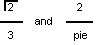 Figure 1.2 are fractions, but they are not rational numbers; they cant be written as the quotient of two integers. All integers are rational numbers. Figure 1.3 shows you some examples. Fig 1.3 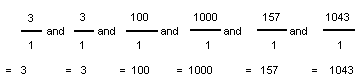 We stated above that the denomenator for rational numbers can not be zero. Fig 1.4 well show you examples why not. Fig 1.4 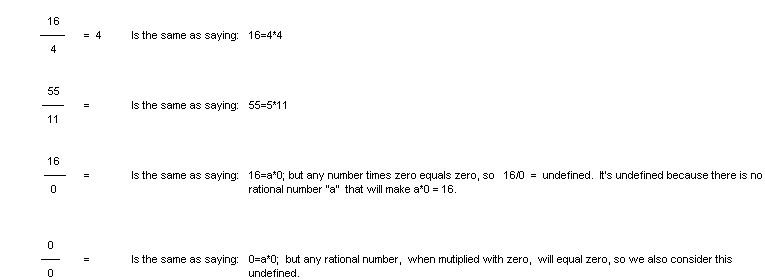 |